FAQs: Rootwell’s Permanent Tree and Shrub Watering and Feeding Solution
Below is a list of frequently asked question about the Rootwell Pro-318 and Rootwell Root Sticks and the answers to each. If you have additional questions, please contact us.
- Why should I invest in the Rootwell Pro-318 tree system?
- Will the Rootwell Pro-318 fill with dirt?
- Why is installation of Rootwell Pro-318 in the planting pit recommended during the initial tree planting?
- How do I plant a tree and where do I put the Rootwells?
- How Many Rootwells Do I Need?
- What Type of Rootwell Should I Use?
- Will the Rootwell Fill Up With Roots and Will it Damage the Roots?
- Why Should I Use Rootwell Over Watering Bags?
- What type of root fertilizer is recommended?
- Do Rootwell Pro-318s need to be moved when the tree matures?
- How long does the Rootwell last?
- What other products are comparable to the Rootwell and the Root Stick?
- Are there any other uses for Rootwell?
- How do I protect the trees from sunburn, weed wackers and general abuse at the base?
- Why should I invest in the Rootwell Pro-318 tree system?
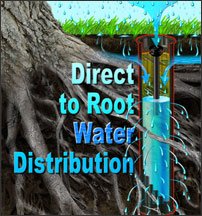
Rootwell Products, Inc.’s Pro-318 direct-to-root feeder system has been engineered to enhance the tree’s natural ability to absorb air, water and nutrients for many years. It is a three-in-one system to promote healthier root systems. This is an affordable permanent system. A smart investment in promoting long-term tree health and growth.Trees are expensive. Rootwell presents the best solution for your tree to thrive in all environments.
- Will the Rootwell Pro-318 fill with dirt?
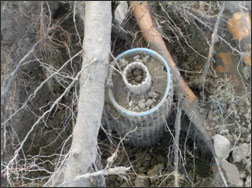
A limited amount of dirt may enter the cylinder. However, it will not reduce the Rootwell’s effectiveness. In cases of extremely fine soil or sandy conditions, use the Rootwell sock accessory to prevent sand fill. - Why is installation of Rootwell Pro-318 in the planting pit recommended during the initial tree planting?
The installation Rootwell Pro-318s are recommended during the initial tree planting because oxygen, water and nutrients can reach the largest mass of roots so that the tree can establish itself more quickly. As an additional benefit, oxygen directed be Rootwell aids in the decaying process of the burlap sack that contains to roots during shipment. Finally, Rootwell will encourage roots to expand beyond the glazed planting pit extending root growth beyond the pit for better root establishment.Sidewalk Tree Plantings With Rootwell
Rootwell Pro-318 expands the effective root zone volume, improves soil oxygenation and efficiently provides tree watering; resulting in larger tree growth.The common 4’x 4’ sidewalk tree well has 2,304 square inches of surface area. An estimated 8 inches of oxygenated soil provides 18,430 cubic inches of usable root growth volume.
Installing 4 Rootwell Pro-318 aeration tubes will displace 509 cubic inches of soil; however, it will add 6,000 cubic inches of oxygen rich root growth space adding 30% available root growth area in the same sidewalk tree-well.
Additionally, each Pro-318 holds 2.2 gallons of water. In a friable soil, the 8.8 gallons of water is delivered directly into the tree root zone “all at once” providing complete tree rootball saturation. Unlike the tree watering bags, its permanent, has no elevated water temperature risk and no risk of vandalism. The 18 inch depth actively oxygenates the soil, helping to relieve the stress of compacted soils on the sidewalk trees.
Installation at tree planting has marginal labor cost and material costs. The return on investment is quickly realized with watering time and water usage reductions. Additional savings are realized when deep root fertilization is included in the planting maintenance schedule.
- How do I plant a tree and where do I put the Rootwells?
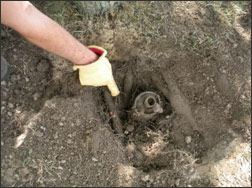
For an easy tree planting guide, please see the USDA’s How to Plant a Tree.Typically the rule of thumb is to dig the planting pit three times the size of the root ball or box if that is used. The size of the tree caliper determines the amount of Rootwells required.
For example if it is a 2” caliper tree, you need two Rootwells. The first Rootwell should be placed North on the compass and the second South. They should be placed half way between the root ball and the edge of the planting pit for easy location in order to water and fertilizer.
- How Many Rootwells Do I Need?
The rule of thumb is to follow the chart below:2” caliper = 2 Rootwells
3” caliper = 3 Rootwells
4” caliper = 4 Rootwells
5” caliper = 5 Rootwells
6” caliper = 6 Rootwells
6″ or more = minimum of 6 and use best judgment to add moreIn addition, use Root Sticks as supplement for additional aeration.
- What Type of Rootwell Should I Use?
The Rootwell Pro-318 is used for all trees and large shrubs. It comes with either a black top or a green top.The Root Stick is used for plants and shrubs. Typically, one or two are used for plants and roughly 6 are used for shrubs.
- Will the Rootwell Fill Up With Roots and Will it Damage the Roots?
The Rootwell will attract the feeder roots which will go into the tube to receive all of the benefits that Rootwell provides. Bigger roots will actually hug the Rootwell and grow beyond it. We have also found that in most cases there is a strong root that comes to the Rootwell and dives deep into the ground to help anchor the tree. There is absolutely no damage to the roots. In fact, they thrive.
- Why Should I Use Rootwell Over Watering Bags?

The reason is that the temperature under the bag can rise to 120° causing harm to the bark and the root system. Water released from watering bags does not go deep enough into the ground to benefit the majority of the root system.
Other problems are mold around the trunk, the introduction of bugs, and softening of the trunk which could be fatal to the tree.
When the water is at the surface, the tendency is for the root to come to the surface, making it susceptible to sun scorch and may cause a tripping hazard.
The Rootwell Pro-318 is below the ground. It directs all the necessary elements including air, water, and nutrients directly to the root system. Water and air is directed deep into the ground encouraging the roots to grow deep.
Rootwell is a permanent system always working for the tree. It is out of sight working 24/7, not like watering bags.
- What type of root fertilizer is recommended?
There are several fertilizers on the market that can be applied directly to roots. Consult your local nursery professional for the recommended brand for your specific plant and its geographic location. Care should be taken not to use fertilizers that will burn the root system. Davey Tree Company has had substantial success with their Arbor Green product used in conjunction with the Rootwell products. - Do Rootwell Pro-318s need to be moved when the tree matures?
No, Rootwell Pro-318s do not need to be moved when a tree matures. They will continue to deliver oxygen, water and nutrients to the growing root system. For ongoing support and maintenance of the tree, installing additional Rootwell Pro-318s to the growing drip line will assure continued root health. - How long does the Rootwell last?
It is fully conceivable Rootwells will last for the life of the tree. - What other products are comparable to Rootwell?
There are no other products that are comparable to Rootwells. Rootwell’s three-in-one patented design is the only product engineered to deliver all the essential elements of life to the root system; oxygen, water, and nutrients. - Are there any other uses for Rootwell?
Yes, they are also used as a means to collect water for extraction or evaporation from the tree root area where the soils are very wet. This will assist the tree or shrub to get established. - How do I protect the trees from sunburn, weed wackers and general abuse at the base?
Young trees need protection against rodents, frost cracks, sunscald, lawn mowers, and weed wackers. Mice and rabbits frequently girdle small trees by chewing away the bark at snow level. Since the tissues that transport nutrients in the tree are located just under the bark, a girdled tree often dies in the spring when growth resumes. Weed wackers are also a common cause of girdling. Plastic guards are an inexpensive and easy control method.Frost cracking is caused by the sunny side of the tree expanding at a different rate than the colder shaded side. This can cause large splits in the trunk. Sunscald can occur when a young tree is suddenly moved from a shady spot into direct sun. Rootwell’s ‘Bark Protector’ tree wraps can be used to protect the trunk from sunscald and does not entrap moisture which will harm tree bark.